Mason Cain
The lawn, perhaps the worst enemy of this page of the website, is a pretty tough place for a bird. It primarily lacks two extremely important things for birds, food and shelter. The lawn, which has one ecologically dysfunctional species dominating it (turf grass, exact varieties can vary), is ideally kept in a manicured state that makes it very hard for many different species to survive in, but this short essay’s focus is its effect on birds; a class of Animalia I have a noticeable bias for.
With the exception of seabirds (which feed their young seafood!) 96% of birds feed their young insects. Our lawns however are not so insect friendly, to say the least. First, they are a monoculture made up of a non-native species. A monoculture (one dominant species) is never good for biodiversity, especially when the plants that encompass it are non-native. These non-natives are basically, actually quite literally, unrecognizable to insects. In fact, the vast majority of herbivorous insects are species-specialist, as in they have simply evolved over millennia to be dependent upon a certain group of plants. They land in our lawns but thanks to evolutionary processes cannot digest the grass, and go without food. When the herbivorous insects disappear the carnivorous will inevitably follow (much like the idea of herbivorous dinosaurs went extinct first then the carnivores followed). Just like we simply cannot eat certain foods, these insects simply cannot eat other species than what they evolved to be able to eat.
We also have a tendency to apply pesticides to our lawn’s, which I imagine I don't need to explain the effect of.
So, when the insects are gone, the birds follow as well. Even if you put out a bird feeder this does not save the species as a whole. Yes, the parents are healthier, but the majority cannot feed their young the seeds you put out (this is what I noted in the first sentence of the second paragraph). If a species cannot reproduce effectively it does not matter how healthy the parents are, once they inevitably die nothing will be able to replace them. For insectivorous species such as the disappearing Whip-Poor-Will even the adults will not be able to survive. According to the U.S Fish and Wildlife Service, over 73% of Aerial Insectivore bird species are in decline. Side note, but Aerial Insectivore species are our birds that catch insects in mid-air, either in flight or from a perch. A great example I have seen of them are Tree Swallows! Even the majority of our non-insectivorous, adult, birds have very insect-heavy diets (this can vary too much by species for me to give an exact number).
And for the small percentage of birds whose whole species life cycle can rely on seeds/grains, such as Mourning Doves, it is important to remember that without a bird feeder they are not going to be able to find much seed in your yard. How many people do you know that consistently stock their bird feeders? That number will obviously be different for each person, but the fact that there aren’t too many naturally occurring seeds in most lawns remains. Replacing your lawn with a variety of native plants will help ensure that even when you forget to fill your feeder the birds are fed.
The reason lawns do not provide much habitat for birds is pretty simple, in fact I think I can summarize it in a few sentences. Lawns don't provide a whole lot of nesting material, maybe just grass clippings.They do not provide cover for birds from predators. Having to go into the middle of a wide open, short-cut lawn makes a foraging bird extremely noticeable and vulnerable to attack. Without any leaves, even foraging during colder months in much of the U.S can be hard (and dangerous) for a bird, as the ground is frozen. A few inches of leaves insulate the ground and prevent it from freezing, allowing overwintering birds such as American Woodcocks to easily access the worms below (while offering some more cover!) Lastly, they do not provide birds with any safe places to roost at night (birds do not spend most of the year in their nest). Lawn's just do not have much material or cover, which is necessary for a bird to have good habitat.
In conclusion, if you want to help birds and reverse the current trend of declining populations, be sure to return even a small portion of your lawn back to native habitat!
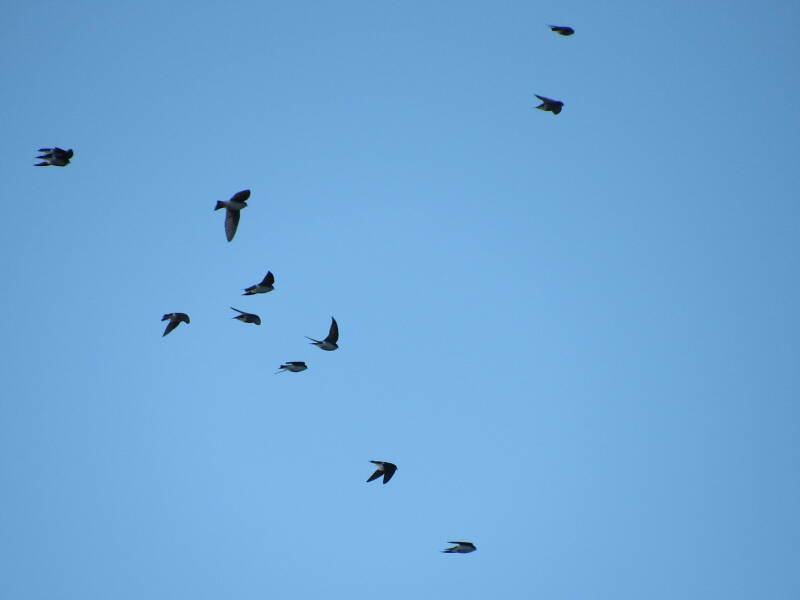
Tree Swallows flying over The Nature Conservancy's South Cape May Meadows preserve, taken by Mason Cain.
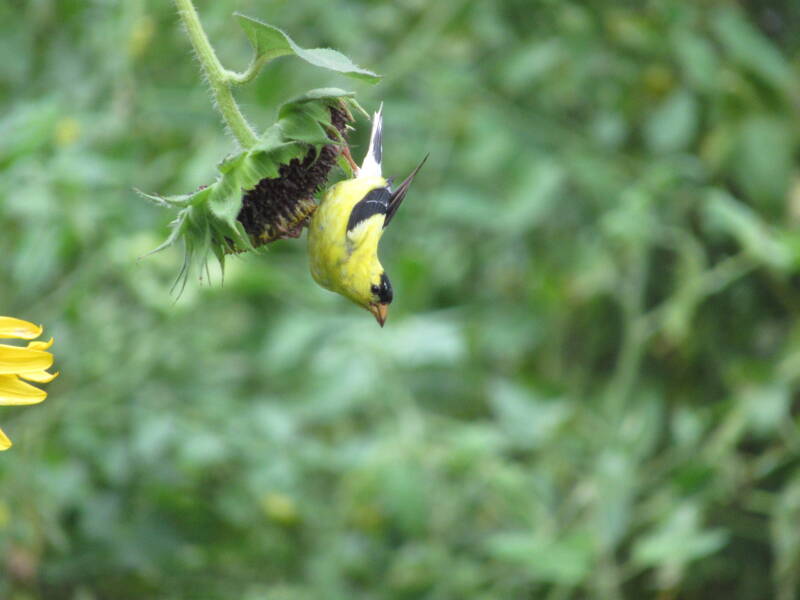
The photo of the Goldfinch eating sunflower seeds was also taken by Mason Cain.
Add comment
Comments
Happy to have found your writings. They are wonderful. This article re: lawns is food for thought. -