Although there may officially be no mascot for the Delaware Bay, a perfect, arguably the best, candidate for this position would be the Atlantic Horseshoe Crab. These ancient creatures exit the waters of the Delaware Bay every year in mind-boggling numbers to breed at their highest concentration anywhere in the world. That's right, despite having a range from Maine to Mexico, the Delaware Bay is home to the largest concentration of these creatures in the world. Despite this, their population is a fraction of what it used to be. Not only have we noticed this decline, but the ecological recipients of their services have felt this blow as well.
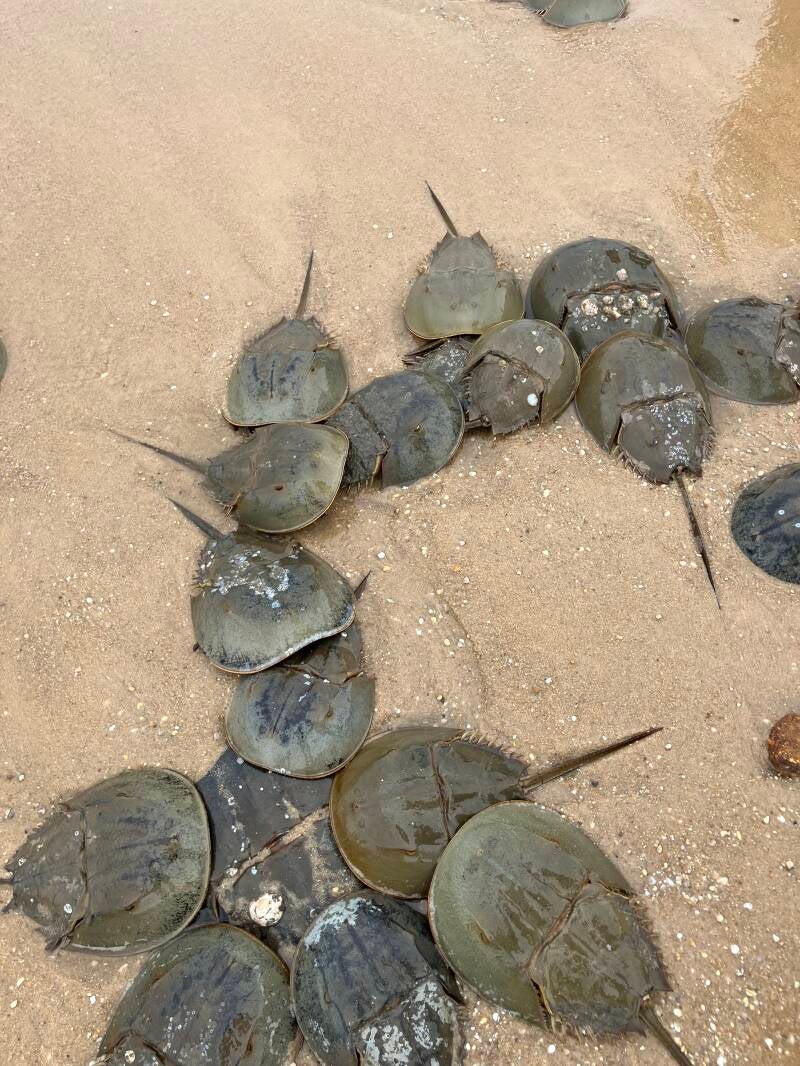
In early summer thousands of Horseshoe Crab's come ashore to lay their beady eggs in the sand of the Delaware Bay. They wait until the water hits 59 degrees fahrenheit, and come ashore in waves of living fossils. They follow the tides, especially the new moon spring tides (which are much higher), onto beaches along the Delaware and New Jersey coast.
They have one goal; to breed. The females come out from the water carrying tens of thousands of eggs in, yes in, their head. They will deposit portions of these eggs in small holes near the inter-tidal line (ideally). The females lay their eggs in clumps containing hundreds of eggs, but by the end of the mating season each female can lay around 100,000 eggs each.
Male Horseshoe Crabs will follow the female, or even clamp onto her, so they can release sperm on the eggs as soon as the female lays them. This is known as external fertilization, and leads to males fighting over a femalez You can actually tell a male from a female because not only are males much smaller, but they also have pinchers meant for grabbing onto the female.
The newly laid eggs will generally hatch after a 2-4 week incubation period, but can this time vary greatly based on temperature. That is incredible, because if you are incubating something like a chicken egg and it gets even a few degrees to cold the embryo just dies. Horseshoe Crab eggs however will just take longer. The newly hatched Horseshoe Crabs also look exactly like adult ones, just much much smaller.
However, for the eggs to hatch in the first place they need to be laid in the correct spot. As the map below shows, most areas on the Delaware Bay are not "undisturbed". The "undisturbed" breeding site has coarse sand that stays oxygenated, as the bigger particles don't compress as easily and therefore leave air between the grains of sand. It also has gently sloping beaches that allow the crabs to easily access the inter-tidal line. When the eggs are laid here they stay moist but not saturated, meaning they stay oxygenated as well. The ideal sight also receives lots of sun and is relatively free of dangerous debris that can trap the crabs. The green on the map is exactly this. The yellow has some flaws though. Perhaps some development that impedes breeding, or even peat/salt marsh that leads right to the water with no sand. The soil of the salt marsh, peat, is anoxic (low oxygen) because it is constantly moist. That is why the salt marsh can sometimes smell like rotten eggs, as hydrogen sulfide is a byproduct of this low oxygen reaction. Any eggs laid in this peat will basically suffocate since there is not enough oxygen. The red is where there is no beach for the crabs to lay on. Along most of the red portions of the bay this is because the salt marsh runs straight into the water, but some is from bulkheads/sea walls.
All-in-all, about 2/3's of the Delaware Bay coastline is potentially suitable for Horseshoe Crab breeding.
After breeding the crabs need to catch the next tide out to sea without getting trapped by debris or on their back. In fact, assuming they keep their book gill's moist, they can only survive out of the water for 24-48 hours, a very slim margin of error to catch the next tide (which changes every 12 hours).

Living Fossils in Peril
Technically there can be no such thing as a living fossil, as fossils are mineralized "things" and nothing transformed into to pure rock can live. However, if it was possible the award would go to Horseshoe Crabs. They have been miraculously unchanged for the past 300 million years, which is unheard of in species. To put into perspective how remarkable that is, dinosaurs existed from 245-66 million years ago. They have outlived dinosaurs! Now somehow the largest concentration of them, especially that of the Atlantic Horseshoe Crab, exist in the Delaware Bay. Yes, they appear along the whole east coast; but not in the beach clogging numbers seen here. The shallow, quickly warming waters that lead to sandy, gently sloping beaches of the Delaware Bay hold the largest spawning concentration of Atlantic Horseshoe Crabs in the world during a natural phenomenon every spring.
However, despite surviving multiple mass extinctions, including that of the dinosaurs, modern man has severely reduced their population over the past 4 decades.

Threats To the Horseshoe Crab
Horseshoe Crabs have been taken for granted for a very long time in the Delaware Bay, and for well over a century have been harvested in ample numbers. Originally this was to be crushed into fertilizer and hog feed, and according to the NJDEP this harvest was even as high as 1 million crabs for 5 decades before sythentic fertilzers were developed.
However in the 1990's we demonstrated just how little we learn from our mistakes. Along the east coast, particularly in New England, fisheries were beginning to collapse as a result of over harvest. So, fishermen started getting involved in the Whelk industry. Horseshoe Crabs are great food for these Whelk, and so they came to the Delaware Bay to harvest crabs for this now growing Whelk industry. As you may have guessed, the Horseshoe Crab population collapsed as well. Harvest went from around 100,000 a year to over 2 million, a 20x increase.
Nonetheless that wasn't sustainable, nor the only problem Horseshoe Crabs in the Bay are facing. Climate change, and the slowing of the AMOC Current is a persistent threat. Habitat Degredation is also a major threat. Erosion, being accelerated by land use and global warming, development, and even the aftermath of Hurricane Sandy all play a role in this. Horseshoe Crabs are also harvested by the Bio-Medical industry for endotoxin testing; which ensures products such as vaccines are safe to be used. They are bled for their blue blood, more importantly their Lysate, and 30% of the bled crabs end up dying as a result of this proccess. Also, crabs are harvested for bait in the Whelk industry to this day, and now the Eel industry as well.

Making Progress?
Right now it is unclear if the poplulation is increasing, or remaining stagnant within the Delaware Bay. However, progress has been made. Beaches have been restored, communities have begun to get involved and more data on these animals is collected every year. So for now we will keep doing what we can, and enjoy seeing these animals every May.
How To Help
-
Advocate for, or even participate in, beach restoration on the Delaware Bay.
-
Advocate for the transition to synthetic Lysate.
-
Participate in programs such as ReTurn The Favor to help save stranded Horseshoe Crabs.
Add comment
Comments
This is a fantastic article, Mason!! We LOVE horseshoe crabs and hope to see more people advocate for their protection.
P.S. we miss you and hope you’re doing awesome!!
Horshie crabs use to creep me out. As I have learned more about them, they definitely are very cool creatures!
Mason,
You should be a reporter! This is a very well written, informative article. Keep up the great work
Great informative article Mason! Why do they have blue blood?
What a great article highlighting the importance of these ancient looking creepy crawlers!!
I never knew how specific of a location the eggs required in order to hatch.
I’m going to try and volunteer to count crabs this year!
Very interesting and impressive Mason! This article was very interesting to read and the pictures were amazing!!
Very well written and informative article. Keep up the good work!
Over 2 million horseshoe crabs harvested is insane! Keep up the great work Mason, will definitely read the next article 🙌